(I forgot to bring a camera on my Chengdu trip, a week after the Xi'an trip. I will just to have to use more words.)
Irrigation System
There is an irrigation system called Dujiangyan (都江堰) not far from Chengdu. It was built in 256 B.C. (or 2,265 years ago), and it is still in use today. With an engineering background, I naturally had a desire to check it out.
This was basically how the system worked: Many, many years ago, the Min River in this area flooded every year. Then a governor of the region named Li Bing (李冰) decided to tackle the problem. He designed a system to divide the river into two, instead of using the old way of dam building. 60% of the river was turned into an "outer river" and continued with the river's old route, while 40% was turned into an "inner river" and became the water source of the farming land surrounding today's Chengdu. In a way, not only the irrigation system solved the flooding problem (the river never flooded again), it prompted the growth of agriculture that made Chengdu a large and rich city.
Later that night we returned to Chengdu city and had hot pot for dinner. Since not all of us could take spicy Sichuan food, we used a "yuan yang wok" for our hot pot. (Yuan yang 鸳鸯 is a type of bird, usually seen in pairs, one male and one female.) There was a divider across the middle of the wok so that one side could be used for spicy flavor, while the other side for non-spicy flavor. I pointed at the wok and said, "Now let me explain to you the irrigation system..."
Earthquake-hit Area
A funny episode when we arrived Dujiangyan on a bus: A few local drivers offered us a price of RMB 1 yuan per person to take us to the front gate of the site, which was about 3.5 km away from where we got off the bus. Sounded like a good deal. So the 4 of us got in a car. After he drove away about 100 meters, the driver stopped the car and began to explain the tourist site. It turned out that the site would charge us RMB 90 yuan per person for the entry (this I knew in advance). After that, we would spend another 90 yuan to get on cable cars to various locations. We could do that, said the driver, or we could take his car and go through a different route outside the gate, seeing the same sites yet paying much less than the 180 yuan per. At the end, we agreed on a deal of 85 yuan per, with him as our tour guide.
In other words, the RMB 1 yuan fare was just a bait. :-) At the end, however, we weren't complaining.
In fact, because of this "customized route" that we took, we were able to see some of the earthquake-hit areas more closely. Dujiangyan was one of the hardest hit cities from the 5.12 earthquake last year. (Yet the irrigation system remained intact; that was another reason that I wanted to see it.) About 12,000 people lost their lives, and 6,000 were missing. (After one full year, i.e. in less than 2 months, the missing would be declared dead as well.)
If at the beginning we were simply curious seeing the damaged houses and even cracked a few harmless jokes, after a while we all became kind of quiet. This was 10 months after the earthquake, and there were still rows of houses or apartments in unlivable shapes. As I was wondering where the people who used to live there went - how many of them were still alive? - my heart became heavier and heavier.
Wu Hou Shrine & Jin Li
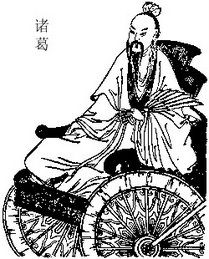
Wu Hou Shrine is one of the most famous places in Chengdu. Wu Hou (武侯) was Zhuge Liang's title after he passed away. (Did I mention already that I am a big fan of the Three Kingdoms (三国) and in particular Zhuge Liang (诸葛亮)?) At the time, Chengdu was the capital city of Shu (蜀), one of the three kingdoms, and Zhuge Liang was the prime minister of the country. He earned the highest respect among people, and his fame exceeded that of the emperor. Indeed, Wu Hou Shrine, which was built in memory of him, became a symbol of Chengdu, not a tomb or a temple for an emperor.
The entrance fee was RMB 60 yuan, and I decided not to spend it. After all, didn't I know about Zhuge Liang enough? :-) Instead, two friends and I walked through a commercial street called Jin Li (锦里), which was right next to Wu Hou Shrine.
Jin Li became famous in the country 2,000 years ago. It was really fun to walk through it, especially if one was familiar with the history and culture of Chengdu (needless to say, mostly related to the Three Kingdoms). While it was free to enter the street, I couldn't help but to spend on a few cute items in the scores of shops. I also had the joy of telling a few Three Kingdoms stories to my friends, both grew up in North America. They walked a lot faster than I did, saving me from spending too much.